Write a sentence. Get a tool that runs on its own.
Marching Orders is a Firefox extension. You type what you want watched or checked, such as "tell me about any 3 to 5 day trip under $400 over the next month." AI turns the sentence into an order: a short list of steps you can read before approving. From then on, plain code carries it out on a timer, in a hidden tab, with no AI involved, unless a step needs judgment.
Why this exists
- People already want small tools for their own chores. Tampermonkey, an extension that runs small user-written scripts on chosen sites, shows about 12 million users on the Chrome Web Store and about 850,000 on Firefox Add-ons (store listings, read Nov 19 2026). Its scripts have to be written in code.
- Today's AI "skills" are saved writing prompts. Chrome's Skills and Dia's skill gallery run a saved prompt on the page you're on when you ask. Nearly every listed example summarizes or rewrites the page. None found runs on its own, watches anything, or works under limits the browser enforces.
- Running an AI on every check is costly, slow and unpredictable. Paul Kinlan's prompt-in-a-box, a Chrome extension whose program is a markdown prompt, calls a model every run. He notes results vary between runs, and his extensions can't go on the Chrome Web Store because they run generated code.
The hypothesis
People who don't write code will make browser tools for their own recurring chores when making one takes a sentence. Those tools keep working, even after being shared, when AI writes the steps once and only steps back in to judge or repair.
The results that would end it (for a friends-and-colleagues study, not yet run):
- Fewer than half of people make a second tool.
- Fewer than half of tools still run after two weeks.
- Most shared tools need changes to work for the friend.
- Tools need AI on every run.
A weak pass would be people only making watchers. That would make it a better page monitor, not a new kind of software.
How it works
- You give an order in the sidebar. With Use this page ticked, the writer sees an outline of the page you're on.
- The writer makes an order, not code. An order is a title, a schedule, the sites it may touch, and steps from a fixed set. The steps are open, click, read items, work out a value, keep, judge, only new, notify, hide and highlight. Claude writes it by default; a local model on your computer can instead.
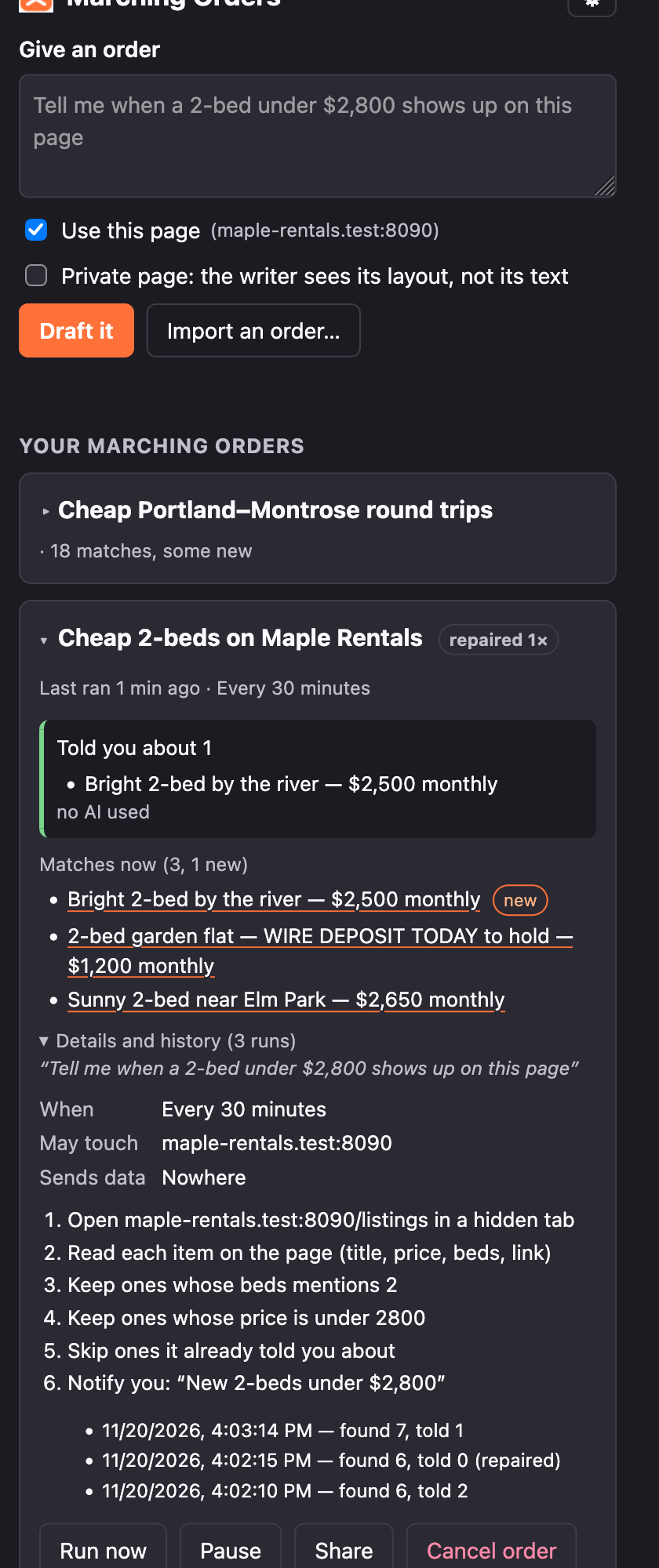
- A practice run happens straight away. It doesn't notify you or remember anything. If it finds nothing, the writer gets a second try, written from the page opened fresh, which is how the order will see it.
- You approve it, and Firefox grants exactly its sites. The card shows what it may touch, what it may click, and whether anything is sent anywhere.
- It runs on its own on a timer (every 30 minutes, every 2 weeks, daily at 7am) or when you open a page. Pages open in hidden tabs, so logged-in sites work without tabs flashing up.
- You see what it found, with links. Each order lists its current matches and marks the new ones. A notification with one match opens it; with several, it opens the list.
- When a site changes, it repairs itself. If reading a page suddenly finds nothing, the writer is asked once to rewrite that one step. The card shows "repaired 1×".
- Orders can be changed. Change puts an order's sentence back to edit. Approving the new draft replaces the old order, and it remembers what was already reported, so nothing is reported twice.
- Orders can be shared as files. There's no code inside, so a friend can read every step before running one.
What was tested
Orders were given in plain sentences. Results are from practice runs and real runs on Nov 19–20, 2026, in Firefox.
| The order | What happened |
|---|---|
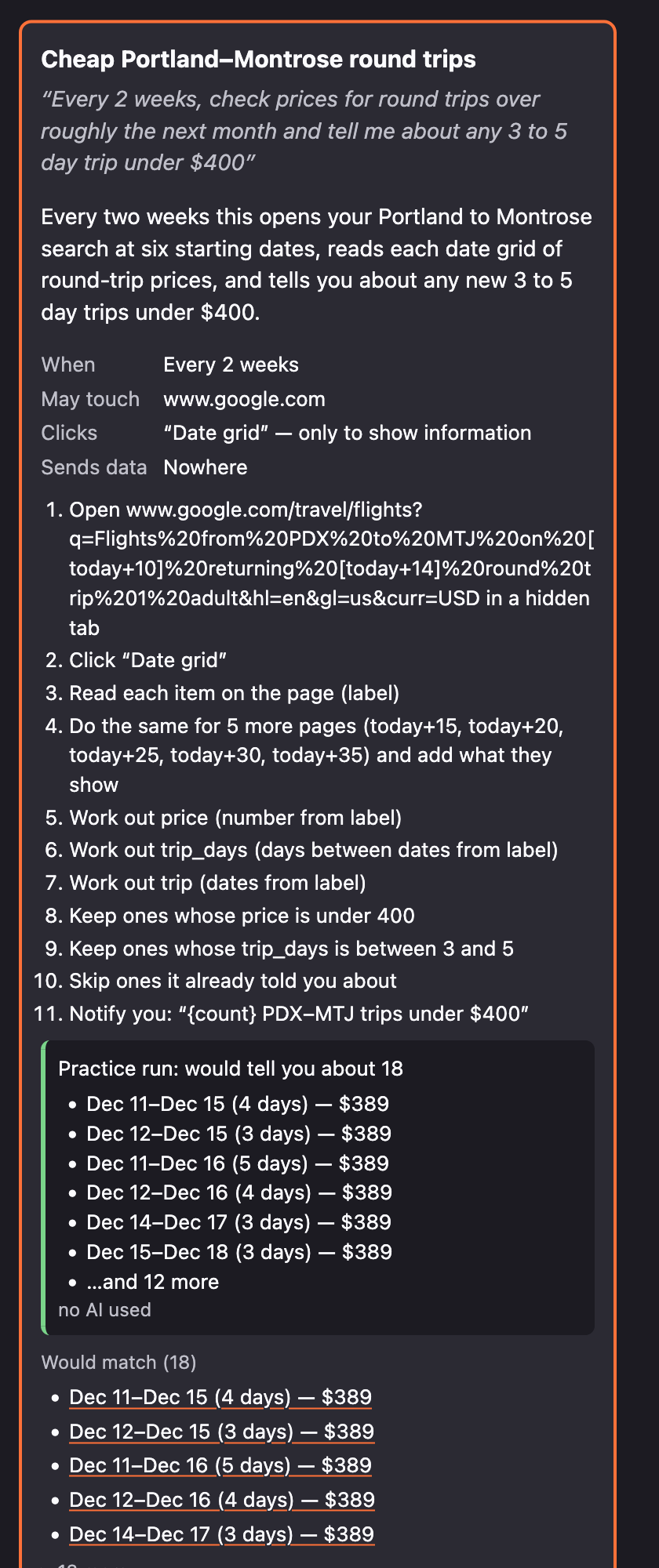
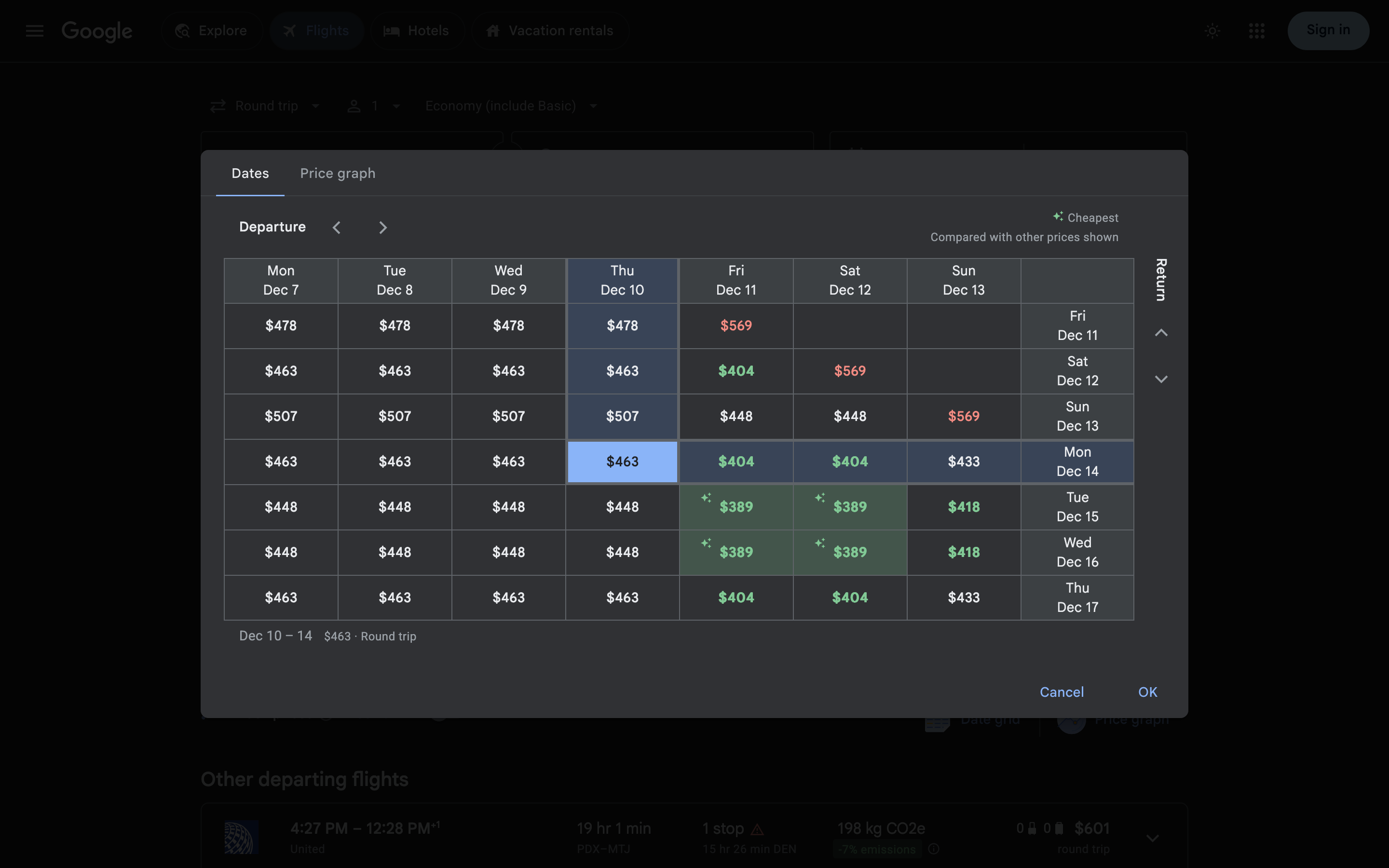
| Google Flights: "Every 2 weeks, check prices for round trips over roughly the next month and tell me about any 3 to 5 day trip under $400" | Opens the search at six starting dates, 5 days apart and relative to the day it runs. Clicks Date grid and reads every price. One run read 273 prices and found 18 trips under $400, the cheapest $374 |
| weather.com: "Every day at 7am… tell me if any rain is expected between 7 and 10am or between 3:30 and 6pm, or if total rain today is more than 0.05 inches" | Reads today's hours, works out the time of day for each, and alerts only if a check passes. Tried against a dry day and a rainy one |
| REI: "Check every week for these climbing shoes under $105 or at least 25% off" | Found 15 matches, with links, in a normal Firefox. REI blocks the automated test browser |
| A credit card's transactions: "Tell me about any purchase at a liquor store, wine shop, brewery, bar or bottle shop once a week" | Written in private mode (below). The weekly check of each purchase runs on a local model |
Who writes the order matters. On three test sentences, tried twice each:
| Claude (Opus 5.5) | Local model (Qwen3 14B) | |
|---|---|---|
| Picked the right items | 6 of 6 | 6 of 6 |
| Filled in the item's link | 6 of 6 | 2 of 6 |
| Needed a second try | 0 | 4 |
| Time per draft | 11–63 s | 1–2 minutes |
The local model couldn't write the bank order at all; the page was too messy for it.
Private pages
Writing an order needs an outline of the page. For a bank, that outline would carry merchant names and amounts. With Private page ticked, every letter and digit is masked before Claude sees it. Claude still sees where things sit and what kind of text each is, which is enough to choose what to read. The real text is read only on your computer, where a local model answers "is this an alcohol purchase?" A private order's judgment steps always run on the local model; the extension enforces this when the order is written and on every run, whatever the order file says.
Nov 18  TOTAL WINE & MORE #1123  $48.12
Nov 17  SAFEWAY 1490             $83.40
Nov 16  BREAKSIDE BREWERY        $22.00
<span class="tx-date"> Xxx 99
<a href="/xxxx/xxxxxxxx/xx/9">
  XXXXX XXXX & XXXX #9999
<span class="tx-amt"> $99.99
A test checks that no merchant name, amount, date, card number or account number reaches the writer, using a stand-in for Claude that records exactly what the extension sends.
How it's made
| Piece | What it does | Where it runs |
|---|---|---|
The writer (Claude claude-opus-5-5, or Qwen3 14B through Ollama) | Turns a sentence and a page outline into an order. Called again only to repair a step | Anthropic's servers, or your computer |
| The runner | Carries out the steps with fixed code. It refuses pages the order didn't list or Firefox didn't grant. It refuses to click anything that buys, books, sends, signs in, submits a form or leads to another site | In Firefox |
| Fixed-code corrections | Fill in what weaker writers miss: a schedule stated in the sentence, a missing step to open the page, a missing notification | In Firefox |
| A relay | Some Anthropic organizations refuse calls made from a browser. The extension switches to a small relay on your computer, which forwards them and stores nothing | Your computer, only when needed |
| Firefox features | Hidden tabs (tabs.hide); a built-in sidebar; a background script that stays awake, so slow local-model calls aren't cut off at 30 seconds. Chrome has no hidden tabs and no longer runs this older kind of extension (verify) | In Firefox |
What it borrows, and from whom
| Project | What Marching Orders takes |
|---|---|
| prompt-in-a-box (Paul Kinlan) | The idea that a sentence can be the program, and that the extension's permissions are the contract |
| Workflow Use (Browser Use) | Run AI once, save fixed steps, replay without it |
| Greasemonkey and Tampermonkey | Small personal tools, installed by the user, that run on chosen sites |
| Agent Guard (this project) | Limits enforced by the browser, not by the AI |
Safe by design
- Orders contain no code. Every step comes from a fixed set, so an order file can be read before it's run.
- Firefox grants the sites, not the order. Approving asks Firefox for exactly the order's sites.
- Clicks are for showing information. Every button an order may click is named on its card, and the runner refuses buying, booking, sending and signing in.
- Page text reaches a model only as data. The judge step is told to ignore instructions inside the items it reads.
- Nothing is sent anywhere by a run, unless an order's judge step uses Claude, which the card says. A private-page order's judge steps never use Claude.
- The study log leaves out what orders found. It records that an order ran and how many items it reported, not the items.
How it could sustain itself
| Route | What it would mean |
|---|---|
| The toolkit people build with | Firefox as the place where personal tools are made, run and shared, with limits a person can read |
| A reference format | "Prompt plus permissions" as a readable order file other browsers and agents could run |
| Holding the person's tools and context | Orders and what they've found stay with the person, in their browser, not on a service |
Questions
Does AI run every time an order checks?
No. AI writes the order once. Runs are plain code. AI is called again only to repair a step when a site changes, or for a judge step, which the card marks "AI each run".
Can an order buy something or send a message?
No. There's no step for typing into forms, and the click step refuses anything that buys, books, sends, signs in, submits a form or leads to another site.
Does it work on sites I'm logged into?
Yes, in your own Firefox, using your session. When the site logs you out, the order says "log in again" and waits. It never asks for or stores a password.
Why Google Flights searches instead of scrolling the grid?
The grid's scroll arrows do nothing in a background tab. Six searches, 5 days apart, cover every 3–5 day trip over about a month.
Is this a Firefox feature?
No. It's an extension built as a research prototype.
What's weak
- No one but its builder has used it yet. The friends-and-colleagues study is the test, and it hasn't run.
- Sites with strong bot protection block the automated test browser, so those can only be tried by hand.
- Orders written against one view of a page (a selected tab) can miss in another. The second draft now uses the fresh page, but the first draft can still be wrong.
- Shared order files aren't signed, so there's no proof of who wrote one.
- A judge step's answer can still be swayed by a crafted page.
Other forms it could take
- Chores, not just watchers. Filling forms under the same limits, for example copying receipts into a spreadsheet.
- Signed orders. Know who wrote a shared order, and what changed since.
- Orders that carry their own checks. Example inputs and expected results, so a friend can confirm one works for them before trusting it.
- Outside the browser. The browser as one tool an order uses, alongside files and programs on the computer.